
Jaisalmer Desert Safari Guide: Sam Sand Dunes, Camel Rides & Overnight Camps
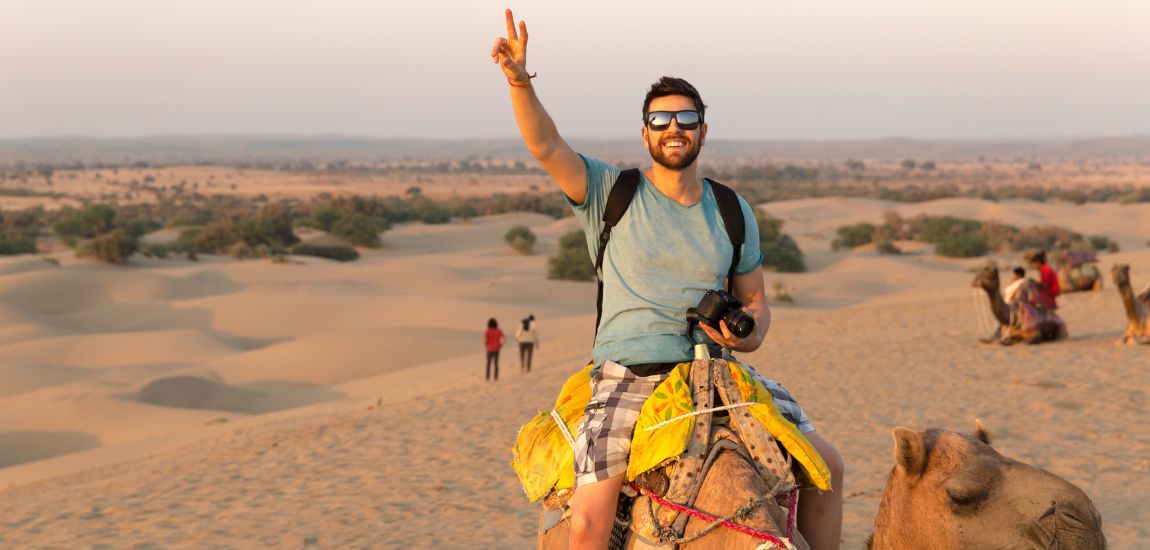
The desert is the reason most people add Jaisalmer to a Rajasthan itinerary in the first place — a sunset camel ride over the Sam sand dunes, a night in a desert camp under a genuinely dark sky, and a golden sandstone fort that still has people living inside its walls. This guide covers the practical decisions: which dunes to visit, camel safari or jeep safari, how to choose a camp, and when to go.
Why Jaisalmer's Desert Experience Is Different
Jaisalmer sits at the edge of the Thar Desert, close enough to the Pakistan border that the landscape around it is genuinely arid rather than the semi-arid scrub you see elsewhere in Rajasthan. The city itself is built almost entirely from a local golden-yellow sandstone, which is why Jaisalmer Fort and the old city glow amber in the late afternoon light — the "Golden City" name isn't a marketing invention. Jaisalmer Fort is also one of the few "living forts" left in the world, with several thousand people still residing inside its walls in homes, shops and guesthouses that have been there for generations.
But the desert itself, not just the fort, is what sets a Jaisalmer visit apart from the rest of a Rajasthan tour. The dunes, the camel safaris and the overnight camps are a genuinely different kind of experience from the palaces and forts you'll see in Jaipur, Udaipur or Jodhpur.
A Short History of Jaisalmer and the Silk Route
Jaisalmer was founded in 1156 by Rawal Jaisal, a Bhati Rajput ruler, on the strength of its position along the overland trade routes connecting India with Central Asia, Persia and beyond. For centuries, camel caravans carrying silk, spices and other goods passed through the city, and Jaisalmer's merchants grew wealthy on the transit tariffs — wealth you can still see today in the astonishingly detailed sandstone havelis built by these trading families in the 18th and 19th centuries. The city's importance faded sharply after the partition of India in 1947 closed the traditional trade routes to what became Pakistan, and again after Independence as sea and rail trade replaced camel caravans. What was left behind, somewhat by accident, is one of the best-preserved medieval desert trading cities in the world.
Inside Jaisalmer Fort — What to See
Jaisalmer Fort (also called Sonar Qila, the "Golden Fort") rises directly out of the old city on Trikuta Hill, and unlike most of Rajasthan's forts, it's still a living, inhabited space rather than a museum piece. Around a quarter of Jaisalmer's old city population still lives within its walls, running guesthouses, shops and restaurants from buildings that in some cases are many centuries old. Inside, the main things worth seeking out are the cluster of ornately carved Jain temples dating from the 12th to 15th centuries, the Raj Mahal (the former royal palace, now a ticketed museum with good views over the city from its upper floors), and simply the experience of walking the narrow lanes between the inner walls, which are lined with carved sandstone balconies and doorways at a density you won't see anywhere else in Rajasthan.
Camel Safari vs. Jeep Safari vs. Overnight Camp
These three terms get used loosely, so it's worth being clear about what each one actually means before you book anything.
| Option | What It Involves | Good For |
|---|---|---|
| Camel safari (short) | A 1-2 hour camel ride, usually timed for sunset, over the Sam or Khuri dunes | Anyone with a day trip to Jaisalmer — the classic, must-do version |
| Camel safari (extended) | A multi-hour or overnight trek by camel further into the dunes, camping along the way | Travellers who want a genuine expedition feel and have flexible time |
| Jeep desert safari | 4x4 dune-bashing over a wider stretch of desert, sometimes combined with a shorter camel ride at the end | Those who want more ground covered and a more active experience |
| Overnight desert camp | A night spent in a fixed or semi-permanent tent camp at the edge of the dunes, with dinner, cultural performances and sometimes a return camel ride included | Anyone staying more than a day trip — the fullest version of the experience |
Sam Sand Dunes vs. Khuri Dunes
The Sam sand dunes, roughly 42km (about 45 minutes by car) west of Jaisalmer city, are the most visited and most developed dune site, with the largest concentration of camps, sunset crowds and camel operators. They're also the easiest to combine with a day trip if your time in Jaisalmer is limited.
Khuri, a little further south and slightly less developed, has a reputation among repeat visitors for being quieter and slightly more authentic-feeling, with smaller family-run camps rather than the larger commercial operations you'll find at Sam. If avoiding crowds matters more to you than convenience, ask your driver about Khuri as an alternative.
- Sam dunes: closer, busier, more camp options, easiest for a day trip
- Khuri dunes: further, quieter, smaller camps, better for travellers prioritising a peaceful evening over convenience
- Both offer genuinely large, photogenic dune formations — not every part of the Thar Desert looks like this
What to Expect at Sunset
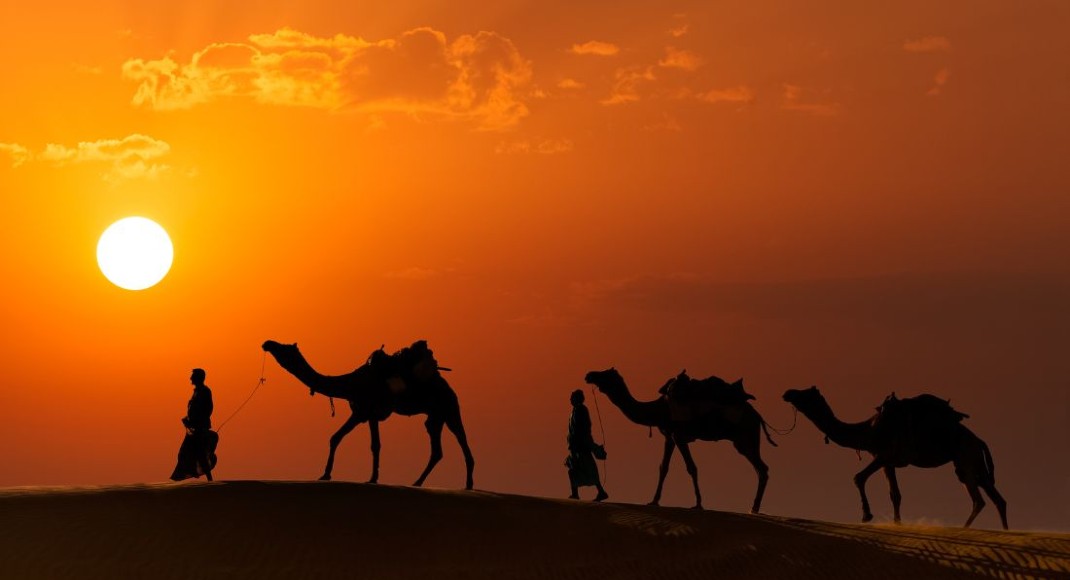
The standard sunset visit follows a predictable but genuinely enjoyable pattern: arrive at the dunes an hour or so before sunset, take a 30-60 minute camel ride out into the dune formations, then walk or ride to a high point to watch the sun go down over the desert. Most camps run cultural performances after dark — Kalbelia folk dancing and Manganiyar musicians are the most common, both genuine Rajasthani desert-community traditions rather than generic tourist shows, followed by a buffet dinner, often cooked over an open fire.
If you're travelling with children or anyone uneasy on a camel, most operators also offer a jeep-only version of the sunset dune visit, skipping the camel ride but keeping the sunset viewing and, usually, the cultural performance afterward. It's worth mentioning this preference when booking rather than assuming the camel ride is compulsory.
Choosing an Overnight Desert Camp
Camps range from simple standard tents with shared bathrooms to "Swiss tents" with attached bathrooms, air-conditioning or heating depending on season, and hotel-standard beds. Price generally tracks these amenities closely. A few things worth checking before you book, beyond the tent standard itself:
- Whether dinner and breakfast are included, and whether alcohol is available or BYO
- Whether a camel or jeep transfer from the parking area to the camp is included — some camps are a short walk from where vehicles can reach, others are further into the dunes
- Whether the cultural performance is included in the room rate or charged separately
- How far the camp is from Sam village itself, since "desert camp near Sam dunes" covers a fairly wide radius
We work with a small number of camps we've used repeatedly and can vouch for, rather than booking whichever one happens to have availability — ask us for a recommendation matched to your budget and what you want from the night.
Best Time to Visit for a Desert Safari
| Season | Conditions | Notes |
|---|---|---|
| Oct - Feb | Cool days, cold desert nights (can drop close to freezing in Dec-Jan) | The best overall window — bring warm layers for the evening regardless of how hot the day was |
| Feb (specific dates) | Jaisalmer Desert Festival | A lively but crowded time to visit, with folk performances, camel races and competitions — book well ahead if your dates align |
| Mar - Jun | Increasingly hot, reaching 45°C+ by May-June | Sunset safaris are still viable since you're avoiding the daytime heat, but daytime sightseeing at the fort is uncomfortable |
| Jul - Sep | Monsoon, though Jaisalmer receives far less rain than the rest of Rajasthan | Generally still operable, but dunes and camps are quieter this time of year |
The Havelis of Jaisalmer
Beyond the fort, Jaisalmer's old city is known for its havelis — grand merchant houses built from the same golden sandstone, with facades carved in a level of detail that can take a mason months to complete a single window frame. Three are usually singled out as the best examples:
- Patwon Ki Haveli — actually a cluster of five havelis built by a single wealthy family in the early 19th century, and the largest and most elaborate haveli complex in the city
- Nathmal Ki Haveli — built by two brothers who reportedly worked on opposite halves of the facade independently, resulting in a building that's almost, but not quite, symmetrical
- Salim Singh Ki Haveli — recognisable for its distinctive curved, overhanging upper storey, said to have been designed to resemble a peacock
All three are within easy walking distance of each other and the fort, making them a natural half-day addition to a Jaisalmer city visit before heading out to the dunes.
Gadisar Lake and Desert Water Conservation
Gadisar Lake, an artificial reservoir just outside the old city walls, is worth a visit for reasons beyond its photogenic chhatris (domed pavilions) and carved gateway — it's a good introduction to how seriously water conservation was taken in a genuinely arid desert city long before "sustainability" was a modern concern. Jaisalmer's historic water system of lakes, stepwells and channels was engineered to capture and store what little rainfall the region received, and Gadisar remains one of the most accessible surviving examples. It's a pleasant, quiet stop, particularly at sunset, and pairs well with a sunset boat ride on the lake itself.
Desert Food Worth Trying in Jaisalmer
Jaisalmer's cuisine reflects its desert setting more directly than food elsewhere in Rajasthan — historically, the region's harsh, low-water conditions shaped a diet built around ingredients that could survive drought and long storage. Ker sangri, made from dried desert beans and berries native to the Thar, is the dish most specific to this part of Rajasthan and worth actively seeking out rather than assuming it will appear on every menu. Dal baati churma (lentils with baked wheat dumplings and a sweet crumbled wheat dish) is the broader Rajasthani staple you'll find everywhere, and many desert camps serve a version of it as part of the evening buffet. If you're at a camp for dinner, it's also worth asking what's specifically local to the Jaisalmer region rather than defaulting to the general North Indian menu that some larger camps offer alongside it.
Kuldhara — The Abandoned Village Side Trip
About 25km southwest of Jaisalmer, en route toward Khuri, Kuldhara is a preserved but abandoned village of stone houses, said to have been deserted overnight in the early 19th century by its Paliwal Brahmin residents. The reasons are debated between historical accounts (heavy taxation, drought) and local legend (a curse placed on the land as the villagers fled), but either way it's an atmospheric, easy stop to combine with a Sam dunes day trip, since it sits more or less on the way.
Suggested Jaisalmer Itinerary
- Morning: Jaisalmer Fort, including the Jain temples inside its walls
- Midday: Patwon Ki Haveli and the other carved havelis in the old city
- Evening: Rooftop dinner overlooking the fort, lit up after dark
- Late morning: Drive out via Kuldhara abandoned village
- Afternoon: Check into your desert camp
- Sunset: Camel ride and sunset viewing on the dunes
- Evening: Cultural performance and dinner at the camp, overnight in the desert
Getting to Jaisalmer & Getting Around
Jaisalmer is the most remote of Rajasthan's major tourist cities, roughly 5-6 hours by car from Jodhpur, which is the most common overland route in. If you're combining it with the rest of Rajasthan, our Jaipur-Jodhpur-Jaisalmer tour package handles the whole route with one car and driver. For getting around the city and out to the dunes once you're there, see our Jaisalmer car rental page.
Frequently Asked Questions
Planning Your Jaisalmer Desert Safari With V Care Tours
We arrange the drive out to Jaisalmer, the camel or jeep safari, and camp bookings with operators we know and trust, rather than leaving you to sort it out once you arrive. Let us know how much time you have and whether an overnight stay in the desert fits your itinerary, and we'll build the rest of your Rajasthan route around it.
Contact us for Tailormade Tours. We Reply Same Day.
TRAVEL TIPS FOR RAJASTHAN TOUR PACKAGES
Tours from USA, UK & Australia
Rajasthan Tour Package from USA
Rajasthan Tour Package from UK
Rajasthan Tour Package from Australia
Tours from Canada, Spain & Europe
Rajasthan Tour Package from Canada
Rajasthan Tour Package from Spain
Rajasthan Tour Package from Europe
New Zealand & India from USA, UK
Rajasthan Tour from New Zealand
India Tour Packages from USA
India Tour Packages from UK
RAJASTHAN & INDIA TRAVEL GUIDES
Planning Your Rajasthan Trip
Rajasthan for First Time India Travelers
India Travel Tips for Foreign Tourists
Budgeting for Rajasthan
Weather & Best Time to Visit
Best Value & Best Service Commitment. Always.